Volume 1 · Opening Lecture
Navigating the Research Process in Economics
Antonio Cabrales · UC3M
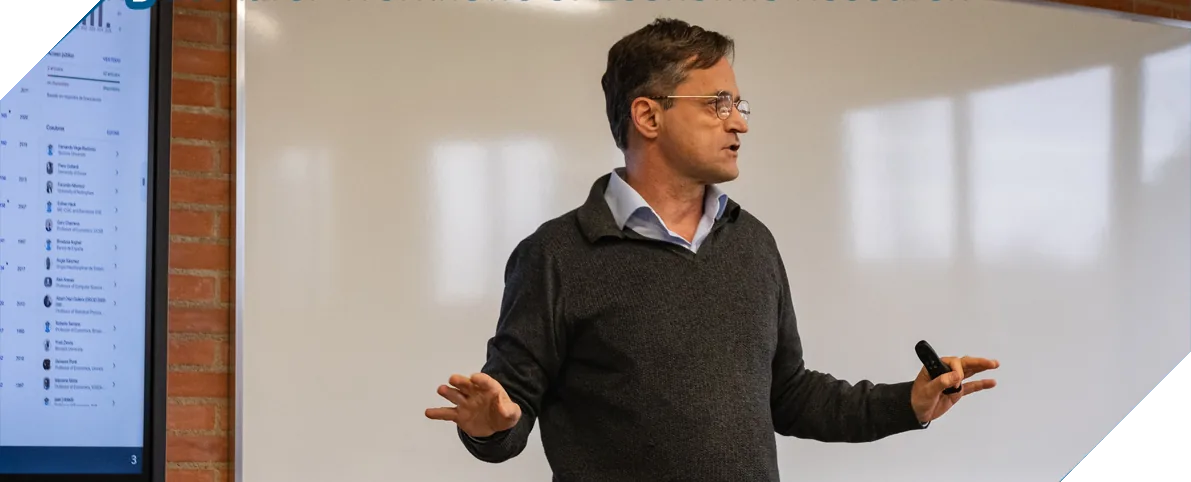
Lecturer: Antonio Cabrales. Antonio is a Professor of Economics at UC3M, and formerly a Professor and Head of the Department of Economics at UCL. He is also the Executive Vice President of the European Economic Association, a Fellow of the Econometric Society, and a Founding Fellow of the Royal Economic Society. Antonio’s research spans a broad range of fields within economics, including game theory and mechanism design, experimental economics, the economics of networks, and the economics of education, among others.
In this lecture, Professor Cabrales provides a comprehensive framework for navigating the research process in economics, outlining the key stages of a study, highlighting critical points, common challenges, and practical strategies to overcome obstacles. He also shares what he would have liked to know when he started this journey.
Contents of this lecture:
Introduction: Research as a Power Law
Research follows a power law distribution: there are far more failures than successes. The likelihood of finding the perfect research idea early in your journey is low. Instead of aiming for immediate breakthroughs, you should embrace the iterative nature of the process. Anticipate challenges and surround yourself with people who can help you navigate them. This is why focusing on creating a safe space and a good work-life balance at the beginning of the PhD will make your experience way more fulfilling.
The following parts of this lecture will cover suggestions for idea generation and evolution, choosing the right methodology, writing and communicating, managing challenges along the way, and preparing for the Job Market.
Step 1: Idea Generation and Evolution
The first step in doing research is to come up with a research idea1. A key strategy for this is to maximize your exposure to diverse topics and perspectives in order to seek inspiration. One useful approach is to attend as many seminars as possible, even those outside your immediate field of interest. The value of knowledge is often unpredictable, so what may seem unrelated today might become crucial in the future.
Ideas emerge from multiple sources: reading both classic and recent academic literature, attending conferences, engaging in discussions with peers, seeking guidance from advisors, conversing with scholars from different fields, and even casual talks with family or following news and podcasts. The key is to explore widely, without the need for in-depth analysis at this stage. There is a nice way of doing this in a more “mechanical” way, that follows two steps: first, think divergently; then, think convergently.
Divergent Thinking: Generating Ideas
Creativity thrives when there are no immediate constraints. To enhance your ability to generate research ideas, practice brainstorming without self-criticism. The critical mind should not interfere with the generative process too early.
One useful technique is to write down subtopics within a broad research area. This exercise can help you identify which themes are most promising or personally engaging. The more ideas you produce, the better your chances of refining one into a viable research project.
Exercise 1. Practicing divergent thinking
Since generating ideas is usually challenging at this stage of your career, here are some quick exercises you can perform, either individually or in pairs, to develop your ability to generate research questions:
Brainstorming. As a starting point, brainstorm individually by writing down all research questions you can think of within 2 minutes, without judging their quality. Then pair up, read each other’s questions, and try to generate new ones from them within another 2 minutes.
Mind mapping. First, pick a broad topic in economics (e.g., climate, gender, immigration, education, taxation, inflation, matching, networks), preferably one you are not currently working on, and then map out all possible subtopics and angles within this topic. Doing so will help you discover new and potentially interesting research ideas.
Convergent Thinking: Refining Research Questions
Once you have generated a list of questions, it’s time to evaluate them critically. When assessing a research question, imagine a colleague asking: Why should I care? Then you can consider some key questions, including:
Is there a gap in the literature?
Does the topic address an important social problem or policy issue?
Can the research contribute to resolving a theoretical debate?
Is the insight from this study applicable beyond its immediate context?...
Admittedly, not all PhD students have complete freedom in choosing their research topics. However, even if you are assigned a topic from the beginning, you can still approach it from an innovative angle. Flexibility in framing your research question is essential for making a meaningful contribution. Moreover, you need to find an angle that motivates you, as you will likely spend a considerable amount of time working on it.
Exercise 2. Practicing the Elevator Pitch
Once you have a good idea, you need to both understand it and be able to explain it to others. This step is crucial, since at this stage you need to get as much feedback as possible. A strong research idea should be explainable in 30 seconds. You should prepare a concise “elevator pitch”. To craft your pitch, develop a brief summary answering the following questions:
Who am I?
What do I do?
How do I do it?
Why does it matter?
This pitch should be accessible to non-experts and should highlight the novelty and importance of your work. A good practice is to try to make someone among your family and friends understand it.
Research Evolution and Sunk Cost Fallacy
You may think you have a great idea and you were also able to turn it into an “elevator pitch”. Yet, research ideas are fluid and will likely change over time. Be open to iteration and refinement, it is part of the process! At the same time, be mindful of the sunk cost fallacy. If a project has been stuck for over a month with little progress, or if you do not anticipate any progress soon, reconsider whether it is worth continuing.
Keeping a steady flow of new ideas prevents stagnation. Therefore, you should continuously alternate between divergent and convergent thinking processes, placing special emphasis on divergent thinking. Then, once one idea seems likely to fail and a better outside option arises, do not hesitate to pivot. It is crucial to maintain a pipeline of fresh ideas rather than clinging to a single project at all costs.
Step 2: Choosing the Right Methodology
Once you have identified a concrete research question, the next step is to select an appropriate method to answer it. The gold standard in empirical research is the randomized controlled trial (RCT), but this is not always feasible (particularly at early stages of a research career). The optimal method will depend heavily on your specific question (and data availability, if empirical analysis is involved). To answer a question empirically, you might be using:
Field experiment/RCT (maybe at a lower scale).
Natural experiment/Instrumental Variables (IV).
Lab experiments (including online and survey-based experiments, or lab in the field).
Web scraping
Administrative data
If you decide to take theoretical approaches, you will have
Game theory
Mechanism design
Matching/coalitional analysis/networks
General equilibrium
Computational methods
These lists are non-exhaustive. The guiding principle should be to select a method that is as complex as necessary, but no more. Over-complicating a study to showcase technical skills can be counterproductive if it does not align with the research objectives. Nevertheless, exploring new techniques at this stage can be valuable and signal that you are able to work with more than one.
Exercise 3. Designing your methodology
You are interested in understanding “how variations in climate in recent years are affecting and will affect violence in schools in the future”. Now take 5 minutes to try to design a study to answer that question. It can be theoretical, empirical, or a mix. It can be a general or partial equilibrium.
Step 3: Writing and Communicating
In the end, as PhD students, you are expected to produce research papers. Even at the early stage, once your idea and execution plan are ready, you need to start writing - otherwise, ideas stay in your mind or in an “Idea # 34543” folder. Effective writing is essential for academic success, though it can sometimes be quite tough. Some useful resources include:
The Little Book of Research Writing (Varanya Chaubey).
A Guide for the Young Economist (William Thomson).
Papers by well-regarded writers in your field (e.g., Drew Fudenberg)
Clarity is key. Your audience may not be intimately familiar with your topic, so clearly explain why your research matters in an accessible and engaging way. While AI tools can assist with drafting, always refine the output to avoid overly abstract or convoluted phrasing. If your writing seems confusing to you, it will be even more to people who have not spent so many hours on your topic. Remember, you want to reach as many people as possible, so give writing an important slot in your agenda!
Exercise 4. Writing a clear abstract
Here are two versions of an abstract, a clear one and a not-so-clear AI-created one. Compare and discuss.
Version 1: We examine experimentally the impact of communication on trust and cooperation. Our design admits observation of promises, lies, and beliefs. The evidence is consistent with people striving to live up to others’ expectations so as to avoid guilt, as can be modeled using psychological game theory. When players exhibit such guilt aversion, communication may influence motivation and behavior by influencing beliefs about beliefs. Promises may enhance trustworthy behavior, which is what we observe. We argue that guilt aversion may be relevant for understanding strategic interaction in a variety of settings, and that it may shed light on the role of language, discussions, agreements, and social norms in these contexts.
Version 2: This study engages with the experimental investigation of the implications that various forms of communication may have on cooperative behaviors and trust-related dynamics. Through a methodological framework that allows for the discernment of commitments, misrepresentations, and cognitive expectations, we analyze the extent to which individual actions align with hypothesized psychological motivations. The findings are interpretable within a framework where actors exhibit tendencies consistent with the minimization of anticipated emotional disutility, specifically in relation to internalized social expectations, a concept that can be linked to psychological game-theoretic modeling. Under conditions where such behavioral patterns are present, communication appears to exert an influence on decision-making processes by shaping second-order beliefs regarding strategic interaction. Notably, the presence of verbal commitments appears to correspond with an increase in behaviors that could be categorized as trustworthy. The broader theoretical relevance of guilt aversion is discussed in relation to its potential explanatory power for a range of strategic contexts, encompassing considerations of discourse, informal agreements, normative structures, and linguistic conventions.
Hints: Pay attention to how the second version over-complicates sentences, adds vague or overly abstract phrasing, and weakens key points.
Challenges along the Way
Doing a PhD is tough - nobody should tell you otherwise. However, a positive aspect is that everyone around you is experiencing similar challenges, creating a great opportunity to share thoughts and support each other. Here are some common challenges and tips to help you overcome them.
1. Changing directions
Hitting roadblocks is part of the research process. Have you recently encountered a challenge that forced you to shift focus? If so, reflect on what led to the change and what you learned from the experience. Flexibility is a crucial skill for a researcher, and self-knowledge is something you will be learning along the way.
2. Time management
Time allocation is a common pitfall for PhD students. We often misjudge how much time should be spent on different activities. Rationalize your schedule by prioritizing research and carefully managing external demands (meetings, calls, emails, etc.). The administrative burden is something PhD students often underestimate when starting their studies. Keep in mind that substantial time will likely be devoted to tasks such as applying for grants, managing conference budgets, or invigilating exams. Having a good organizing strategy is crucial, and remember that you can always ask senior PhD students how they handle these challenges. Some examples of productivity strategies include:
Dedicated Research Blocks: Aim for two or three uninterrupted 90-minute research sessions every day - no chats, no smartphone, no distractions, nothing else! You can adapt the duration and frequency according to your schedule and maximum attention span.
Identify Your Chronotype: Align your schedule with your natural energy levels, and plan deep work during peak productivity hours.
Learn to Negotiate: Many academics struggle with negotiation. Getting to Yes by Roger Fisher and William Ury is a helpful resource. Effective negotiation skills can help you set appropriate meeting times or manage shared office spaces efficiently.
Exercise 5. Negotiating and “Managing Others”
Scenario: Your office-mate spends large amounts of time on Zoom talking very loudly. It is very distracting. You do not have the luxury of a nice room at home to work, and you need to be at the office. Now get in pairs, and negotiate about the issue. You have 5 minutes.
3. Dealing with Bullying and Harassment
Unfortunately, bullying and harassment occur in academia. If you encounter such behavior, it is important to speak out. Here are some actions that you can take:
Confirm that what you are experiencing is bullying.
Seek support - most universities have mechanisms in place.
Consider both formal and informal complaint routes.
Know what to expect after filing a complaint, including potential outcomes, and prepare yourself accordingly.
The most important thing is to feel safe in your workspace during your PhD (and in all aspects of life), so take this as seriously as it deserves. Find someone you trust to talk to, and act promptly!
Bonus: Preparing for the Job Market - It is too early, and it is not too early
The job market is that scary thing that happens when you are about to finish your PhD. Being ready for it is important, and there are some things that must be considered since the beginning, even though it seems far away. This is because success on the job market requires continuous intellectual engagement, so here are some suggestions that may be interesting to bear in mind since the beginning of your PhD:
Maintain an idea notebook to capture spontaneous research thoughts.
Set a weekly goal to generate new research questions.
Always be prepared to answer: Why is this important?
Network widely and be open to adjusting your research focus based on feedback.
Overall, the journey you are starting may feel frustrating at times, but it is also one of the most rewarding experiences you can have. By embracing experimentation, critical thinking, and adaptability, you can navigate the PhD effectively and lay the foundation for a fulfilling research career. Two final suggestions would be: 1) Try to concentrate on the activity, not the results. 2) Be ready to explore new ideas and build coalitions.
This was a broad overview of the entire process, so at this point, you may feel a bit overwhelmed - but don’t worry! The next lectures will zoom in on specific stages of the journey and help you clarify any doubts about this exciting experience.
Notes
The next lecture covers this step extensively.↩︎