Volume 2 · Lecture 4
Academic Talks in Economics
Jenifer Ruiz-Valenzuela · UB & IEB
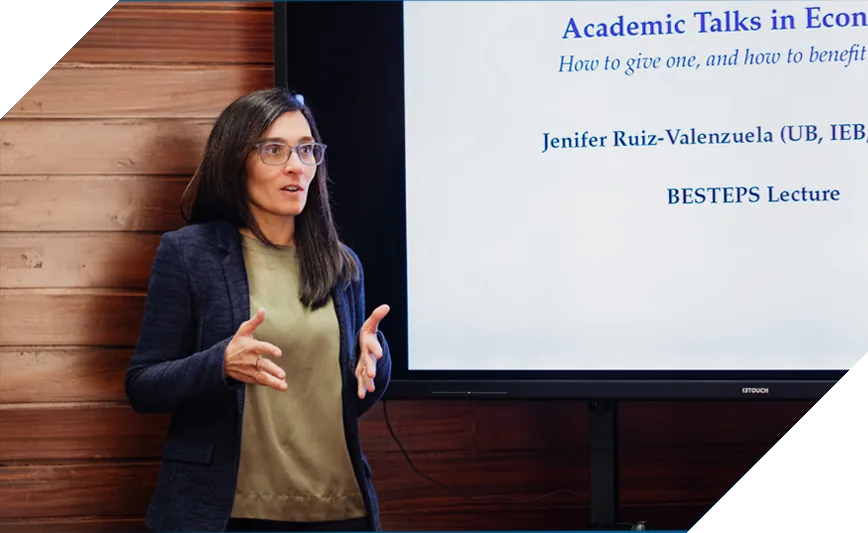
Lecturer: Jenifer Ruiz-Valenzuela. Jenifer is an Associate Professor at the University of Barcelona and co-Director of the Public Policies Research Line at the Barcelona Institute of Economics (IEB). She is also a Research Associate at the CEP at LSE. Her research spans the Economics of Education, Labour Economics, and Public Economics. Known for her engaging communication style, Jenifer is a highly effective speaker in both academic and other public spheres.
Presentations are a central component of the PhD journey, shaping how research projects are conveyed, evaluated, refined, and disseminated through seminars, workshops, conferences, the job market, and beyond. This lecture covers the various phases of preparing and delivering an academic talk, as well as how to benefit from one. It also extends beyond standard presentations to address other common formats, such as posters, discussant roles, elevator pitches, and interactions with the media.
Contents of this lecture:
Public speaking is a core skill for an academic. You need to sell your research, much like a vendor selling tomatoes at a supermarket. Presenting your findings to fellow economists or other interested audiences is an essential part of that process. While some academics are uneasy with this framing, selling in this context is not about exaggeration or marketing tricks. Rather, it is about giving the audience the information they need to understand the contribution of the paper and to see why the results matter.
Therefore, pursuing a PhD is not just about producing rigorous analysis and novel results; one must also obtain the ability to communicate them clearly, convincingly, and confidently to a wide range of audiences. The success of a project depends not only on its technical merits but also on how well it is conveyed. This lecture provides practical guidance on preparing, delivering, and benefiting from academic presentations throughout the PhD and beyond.
Start Presenting Now
It is never too early to start giving presentations. Internal presentations, such as “work-in-progress” seminars in your department, can and should start as soon as a researcher has a research idea. These early talks do not require polished results, let alone a complete paper. Their purpose is to practice explaining the idea, clarify the intuition behind the strategy, and receive feedback that can help push the project forward. Presenting unfinished work internally is one of the most effective ways to learn how others perceive the project and where confusion arises.
External talks, including conferences, workshops, and invited seminars (later in the career, of course), impose higher standards. In these settings, you need a story to sell, and the project should be quite polished, even if the analysis is not completely final. First impressions matter, and there is only one chance to give a first impression. For this reason, it is advisable to present externally only once the core idea, data, and empirical strategy are well developed and defensible. Over time, as you gain experience and confidence, these standards naturally become easier to meet.
Applying to conferences can be a useful commitment device, forcing progress toward a deadline. It is also a tool to examine the readiness of the work for external presentations. However, submitting work that is not sufficiently developed could be counterproductive. A good rule of thumb is: results do not need to be written up perfectly, but they should exist clearly and robustly in the analysis.
It is worth noting that Job Market Paper1 presentations require particular care. The appropriate level of polish depends on who is in the room. If potential employers are present, the paper must be highly refined, and you must be able to defend all aspects of the work. At the same time, Job Market Papers benefit enormously from being presented many times beforehand in “low-stake” settings, either internally or external student workshops, and with close coordination and feedback from advisors.
Before the Talk: Design Slides and Rehearse
When preparing for the talk, remember that you are a seller. People would want to buy your product if they feel they understand it and see its value. As Rafe Meager puts it: “You must give people the information they need to understand the results you will show them, and to see why the results matter.”
Slide Design: Principles
Slides play a supporting role in academic presentations. Their purpose is not to store all relevant information, but to guide the audience through the argument and to reinforce the speaker’s explanation. Well-designed slides reduce cognitive load, help listeners remain oriented, and make it easier to follow the logical structure of the talk.
A fundamental principle of slide design is simplicity. That is, each slide should convey a single idea as clearly as possible. Try to write at most one line per point. You should absolutely not clutter slides. Put as little information as possible to convey the point. Overly dense slides or long blocks of text quickly overwhelm the audience and make it difficult to understand where the presentation is going. As a rule of thumb, if a slide feels crowded, it should be split into two. If an idea requires substantial explanation, it should be delivered verbally rather than written out in full. Also, avoid typos!
When designing slides, visual emphasis should be used sparingly and consistently. A clear visual hierarchy, selective use of bold text, and restrained use of color help emphasize key messages without distracting from the content. Remember, emphasizing everything is emphasizing nothing.
Whenever possible, use graphs over tables for communicating results. Visualizations allow audiences to grasp patterns, magnitudes, and dynamics at a glance, something that is difficult to achieve with dense regression tables2.
If tables are necessary, they should be adapted for presentation to be readable during the talk (from a distance without effort!). What you should not do is simply copy-paste the whole table from your working paper. Presentation tables should show only crucial information, such as the main point estimates, control summary ticks, and the number of observations.
Common Supporting Slides
Whether to include an outline slide depends on the context. In short talks like conference presentations, an outline is often unnecessary and can consume valuable time. In longer seminars or talks with unconventional structures, especially when having multiple methodologies or distinct sets of outcomes, an outline can help the audience stay oriented or highlight mechanisms. Besides, a brief preview of the main results can be useful in long talks, especially if there is a risk of running out of time.
For literature slides, the goal is not to provide a comprehensive survey, but to situate the paper in the current literature. Therefore, you should only include those very related papers. Highlighting how you differ from existing studies (i.e., your contribution to the literature) is far more important than listing many citations.
Since credibility is a primary concern for academic audiences, robustness checks are a common component of any presentation. Core robustness exercises should therefore appear in the main slides, integrated naturally into the narrative. At the same time, not all robustness checks need to be shown upfront. Additional analyses can be placed in backup slides and used selectively when questions arise.
When presenting models in empirical work, simplicity and clarity are crucial: assumptions should be stated explicitly, technical jargon should be minimized, and theoretical predictions should be clearly linked to the empirical analysis.
Rehearse your Talk!
1) Why should I rehearse? Rehearsing a presentation is essential because it substantially improves the quality of the talk. From the perspective of the audience, preparedness shows that you take the presentation seriously and signals respect for the attendees. People do not want to waste their time sitting there for a poor presentation.
For you, the presenter, if you rehearse well, you will feel more confident and less anxious during the talk. You will rely less on the slides; you will read less and explain more, and engage more naturally with the audience. With enough rehearsal, you will also be able to use more precise language, making arguments clearer and more convincing. It helps identify weaknesses in the narrative, unclear transitions, or unclear intuition. Still, you will make mistakes, but fewer and smaller ones with rehearsals.
2) How can I rehearse? Rehearsing by yourself is the first and most important step. Timing the presentation, recording it, and observing one’s own delivery can be extremely informative. You will be able to notice any distracting body language, like arms crossed and hands in pockets. It also helps to detect excessive use of filler words and unclear explanations. For non-native English speakers, rehearsal is particularly valuable for practicing the pronunciation of frequently used terms not natural in their native tongue. Video conferencing tools can be helpful at this stage, as transcripts can reveal repeated phrases or sections that are difficult to follow.
Practicing with your PhD colleagues is usually a helpful next step once you have mastered the individual rehearsal. Feedback from peers frequently highlights points of confusion that you may not anticipate and helps refine both content and delivery. Besides, as PhD students, providing detailed feedback for one another during these internal practices is a powerful way to foster mutual support and improve your presentation deliveries.
Presenting in internal work-in-progress seminars provides additional benefits. You would want to invite more senior researchers to attend your internal talk and hear what they think about your project. Constructive criticism from faculty members is an important input into improving the quality of the presentation.
Finally, the intensity of rehearsal should depend on the importance of the talk. For high-stakes presentations, such as Job Market talks, a stricter rehearsal discipline can be useful. Restarting the presentation from the beginning after a significant mistake reinforces fluency, sharpens transitions, and helps ensure a smooth and confident delivery.
Final Details before the Talk
Knowing the audience is critical. This is especially useful when designing the motivation slides. More specialized audiences, such as in a field-specific workshop, require a targeted motivation that dives quickly into the contribution, while a more general audience requires a broader “big picture” hook. Later in the career, when invited to give departmental seminars, it is often helpful to check the websites of the department and faculty members to understand the background of likely attendees.
Practical considerations also matter. First, clarifying logistical details in advance, such as the total time allocated, whether questions are taken during or after the talk, and how time warnings are given, reduces uncertainty and anxiety. It is also important to pay attention to dress codes. In general, you should neither be dressed too casually nor too formally. Try to strike a balance: avoid wearing either sweatpants or full suits (except for Job Market talks, where suits are less out of place). Lastly, in some talks, you might need to bring water, a pointer, and a backup of your presentation on a USB drive. These small details can all contribute to a smoother experience.
Deliver the Presentation
Calm down, you’ve got this! It is important to remind yourself that you are the person who knows the most about your paper. Before your presentation starts, depending on the setting, you can try to have some minutes for yourself, go to the toilet, and motivate yourself. In the first few minutes at the beginning of the presentation, you will feel the greatest nervousness. Here are some tips to handle this:
Use the title slide wisely to calm down.
Thank the person keeping track of the seminar and the audience.
Briefly introduce yourself and co-authors.
Explain in a couple of sentences what the paper is about.
Delivery: It’s Your Stage
Do not start with an apology: try to inspire confidence. Confidence is conveyed through posture, movement, and tone. You should avoid standing still in front of the slides. Instead, move your body naturally, use your hands, and speak clearly and at a measured pace. A little reminder: do not use a pen that you can click on and off.
Academic presentation is a dialogue, not a monologue. You will need to interact with the audience. The basics are to look at your audience and talk to them, not at your slides or the air. In order to keep them engaged, make sure that you speak loudly enough so that people in the back of the room can hear you clearly without effort, and do not talk too fast. Also, be careful with jokes. A spontaneous light joke is fine, but you don’t want to offend someone or make the talk unprofessional with edgy jokes.
Finally, be a careful tour guide for your project. Important concepts should be explained clearly from the moment you mention them; never assume a concept is self-explanatory. When figures or tables appear, you should actively guide the audience through what they are seeing and why it matters.
Handling Questions
Questions are an integral part of academic presentations. The mindset should be: Questions are good, they make your research better. When handling questions, make sure you first listen and then reply. Besides, it is often helpful to take brief notes on important comments (or ask someone to do it for you).
1) Listening. Questions should be approached with openness rather than fear. All questions are important; don’t dismiss any. When listening to the question, you should look at the person and nod with your head, just to show that you are actively paying attention. Questions should not be interrupted; wait until the question is over to reply.
2) Replying. Don’t start with “It’s a good point” in every answer. Even though you don’t want to dismiss any question, not every question reflects a valid concern. If a question will be addressed in the upcoming slides, it is appropriate to say so and postpone it. When unsure about an answer, it is better to acknowledge it by saying that you need to think more carefully about it. Be careful with extra-long answers when you feel too comfortable.
Defending your work (especially your identification and model) is both legitimate and expected; argue nicely why you don’t agree with certain points made by the audience, and do not get defensive. If there is criticism, it’s of the project, not about you. It is possible to have a pushy attendee in the audience, you can always say “This is important, but if you don’t mind, we can continue the conversation after the presentation,” when they won’t let a point go.
Managing Time Constraints
Use a watch or a timer on the phone to keep track of the time. You can also kindly ask the chair/organizer or a colleague to give you a signal when you have, say, 10 or 5 minutes left.
Even though you have prepared a lot, you might still run out of time. This can happen particularly if there are many questions. When this happens, the session chair or the seminar organizer might help pause questions for a few minutes so you can at least finish your main points.
If you realize you are not going to make it to the end, do not try to rush quickly through all your slides. Instead, focus on presenting the most important and convincing results, ensuring that the narrative of the paper and its central contribution are clearly communicated.
After the Talk
You’re not done (yet) when the presentation is finished! To make the most of your presentation, follow-ups are necessary. As a natural extension of the talk, you can try to reach out to the person who had any unfinished conversations or questions. Reach out also if you did not fully understand a comment. These can lead to productive exchanges or even future collaboration.
Writing down a list of the comments as soon as possible helps preserve valuable feedback that might otherwise be forgotten. In the notes, you would want to explain the content of the comment and write down your answers, or try to look for them if you did not have an answer. After presenting 2 or 3 times, many comments reappear, and by taking notes and reflecting on them, you will perfect the answer to those questions!
In some contexts, such as invited seminars or job market talks, it is appropriate and professional to send a brief thank-you email to the organizers.
Attend Presentations: How to Benefit
Presenting research is only one side of academic exchange. Attending seminars and workshops effectively is equally important for learning, generating ideas, and building professional relationships. Academic talks provide exposure to new questions, methods, and perspectives, and they are a central setting in which researchers learn how others think, argue, and communicate.
Simple habits, such as sitting in the front rows and minimizing distractions (put your phone away!), make it easier to focus during the presentation. Writing down some notes or key points helps understand the talk better (especially using old-fashioned notebooks). It is very natural to have doubts during the presentation. By asking questions, you can deepen understanding and contribute to the discussion, but it is important to pay attention and ensure not to ask repetitive questions.
Most departments and research groups have a weekly seminar in your (loose) field featuring invited speakers from an external institution. Engaging with these speakers outside the formal presentation is often just as valuable as the talk itself. As a PhD student, you should try to sign up and talk to the speakers. When meeting with a speaker, introduce yourself as a PhD in a specific field. You can often discuss a research idea (motivation, identification, results). Productive conversations may also focus on questions you have about a paper by the speaker that you are interested in. Conferences and workshops also offer a great opportunity during breaks or meals to approach a presenter whose work interests you.
Over time, regular exposure to cutting-edge academic presentations also sharpens your intuition about what makes a research question compelling and how strong arguments are constructed, and contributes to the development of your own research agenda. In this sense, benefiting from academic talks is not only about absorbing content and talking with presenters, but also about learning how good research is done and communicated.
Posters, Discussions, and Pitches
In addition to standard talks, there is a range of other formats of presentation. While the objectives and time constraints differ, all formats benefit from clarity, focus, and an awareness of the audience.
1) Posters. It’s all about the visuals. Poster presentation is a format in which you are more of a seller than in talks. Think of yourself again as a vendor standing in the market with your product while your potential audience passes by. Since interaction is often brief, you should choose wisely the main result and the main mechanism to include in your poster.
At the beginning of the poster session, probably no one is stopping by. WHAT TO DO? You should try to make eye contact and smile at people walking by. Very likely, someone will then stop at your poster. To break the ice, you can start by asking whether they are interested in learning about the impact of X on Y. Again, very likely, people tend to be nice and say yes! If you manage to do so, the “contagion” starts, and other people will also stop by.
2) Discussions. Serving as a discussant requires a positive attitude and a constructive mindset. You don’t want to be the toxic element in the room! To make a good discussion, it is advisable to prepare a few slides, if allowed, or some clean and organized notes. This typically starts with a very brief summary of the paper before moving on to the discussion part, which typically includes:
Pointing out the nice aspects. These could be, just to name a few, the contribution, the great data, innovative research design, or unexpected policy implications.
Your contribution. You can flag potential robustness checks, suggest additional analyses (e.g., other outcomes or likely mechanisms), mention literature that could help the authors, discuss policy implications that were not mentioned, etc.
Throughout, it is important to respect the allotted time and maintain a collegial tone. Remember, this is not your show, but to help others improve their projects.
3) Elevator pitches. This format is an extreme test of clarity. Pitches typically last no more than 30 to 60 seconds, or 100 to 150 words, if you draft them. You should avoid technical language and jargon at all costs. An effective elevator pitch:
grabs the attention immediately by starting with a clear and engaging research question,
explains what you are doing and why the question matters,
states the main result in simple terms (answer to the question),
ends with a hook or next step –something memorable or actionable.
Practicing elevator pitches with non-academic audiences (your parents/grandparents, friends who are not economists, etc.) is a useful way to ensure that the core message of a project is truly clear.
Bonus: Talking to the Media
Engaging with the media is a whole other talk, even though some of the points in the previous sections are still valid. Media formats are often unfamiliar, time-limited, and less forgiving than academic settings. When contacted by the media, ask for questions in advance. And then you will prepare a lot for it. If you get any question unprepared for, bridge unexpected questions back to prepared messages (e.g., “This is a good point, but what I can tell you from my research is…”).
Different formats, different strategies. Bring notes for recorded interviews and radio. Television appearances benefit from practicing body language and avoiding distracting clothing. Regardless of format, the guiding principle remains the same: clarity, preparation, and control of the message. The last piece of advice is always to ask any questions beforehand: time, microphone type, standing/seating, etc.
This lecture discusses how to give an academic presentation and how to benefit from one. It is never too early to start presenting. When preparing for a talk, use a simple slide design and rehearse as much as possible. During the talk, be confident, interactive, and professional, and remember to handle questions with openness. Beyond presenting, junior researchers benefit from attending talks to shape good academic taste. Finally, mastering other formats of dissemination ensures research is effectively communicated throughout the PhD and beyond.