Volume 2 · Lecture 5
Crafting the Job Market Paper
Albrecht Glitz · UPF & BSE

Lecturer: Albrecht Glitz. Albrecht is an Associate Professor at UPF and BSE, a Project Leader at RFBerlin, and a Research Fellow at CEPR, IZA, CESifo, and CReAM. His research spans Labor economics, migration, and the economics of espionage. Having supervised numerous PhD students and served repeatedly on hiring committees, Albrecht brings first-hand insight into how to craft a well-positioned Job Market Paper that signals the ability to produce independent and high-quality research.
This lecture focuses on how to write the most important research product during the PhD journey: the Job Market Paper (JMP). The JMP is by far the most important item considered by prospective employers in the job market.1 During the PhD, one should focus their research efforts on the JMP. As a PhD Candidate entering the market, it is more important to have one finished JMP than many papers at earlier stages. In principle, the JMP should look like a paper in a top economics journal and should be written at the highest professional level for a wide audience of highly trained economists. This lecture is also helpful for writing other papers besides the JMP.
Contents of this lecture:
The Job Market Paper
While the PhD dissertation typically includes three related or unrelated papers as its chapters, the JMP is more than just a chapter and must stand alone as one self-contained, polished paper, written as if it could be submitted to a top journal.
The primary purpose of JMP is to show that you can carry out a significant piece of independent research. It should be your most important written research product on the market; it should demonstrate originality, rigor, independence, and taste; it serves as a signal of your long-run research agenda. It is probably the only document that employers actually read before flyouts!
When departments receive hundreds of applications, committees review dozens of applications under tight time constraints, and the Job Market Paper becomes the decisive factor in determining which candidates advance to interviews. Furthermore, departments read the JMP not only to evaluate the specific project but also to infer your trajectory as a researcher: what you have been able to do during your PhD is interpreted as a signal of what you will do in the years ahead.
A successful JMP therefore has to have five elements: a clear and important question, a credible identification strategy or tight theoretical logic, a meaningful contribution relative to existing work, a clean exposition and professional presentation, and evidence that you can generate a stream of future papers.
The Structure & Writing Guidelines
Like all other research papers, a JMP includes a title, an abstract, an introduction, and a conclusion. The typical empirical and theoretical JMPs then differ in emphasis in their body parts. While this structure is typical, it’s not set in stone. Researchers may add sections when necessary (such as case studies), but should have good reasons for deviating from the standard format, as any deviation will draw attention from readers.
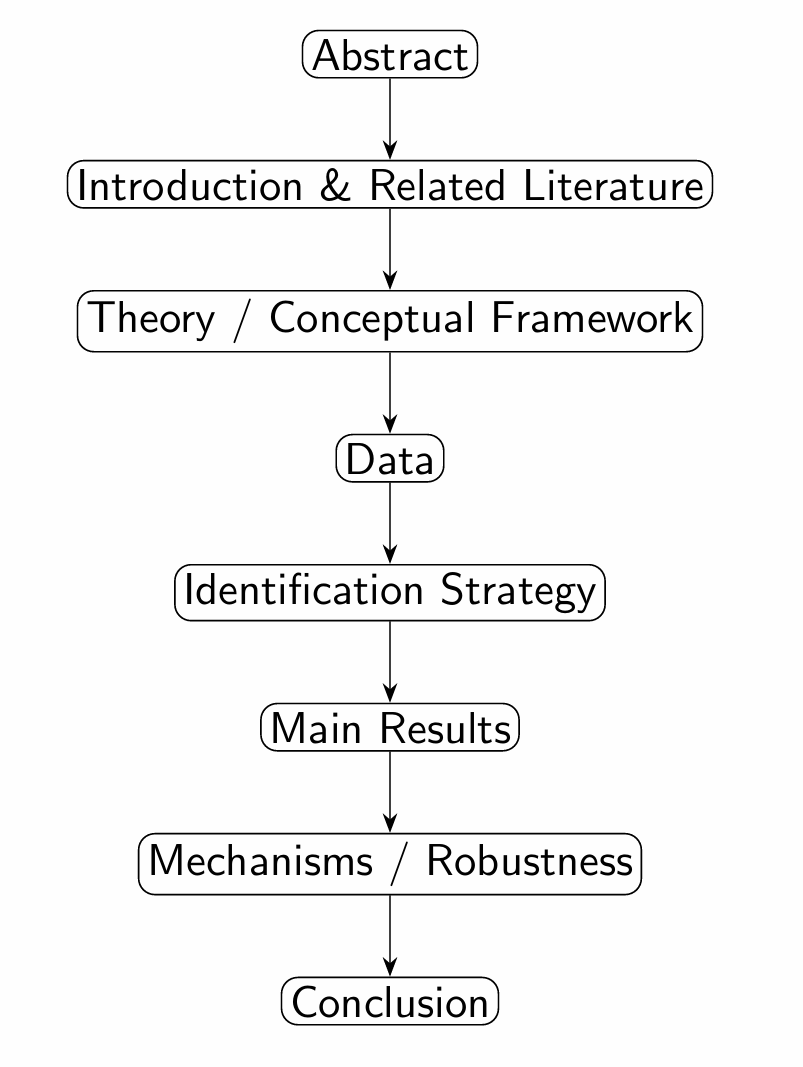
An empirical JMP (Figure 1) typically begins with an introduction that lays out the research question, motivation, and contribution. It then provides a conceptual framework, along with the necessary context or institutional background. Following the description of the data, it describes the identification strategy and presents the main results. Subsequent sections explore mechanisms, heterogeneity, and robustness, before concluding with the broader implications. Technical details, proofs, and data cleaning are usually placed in an appendix, keeping the main text clean and accessible.
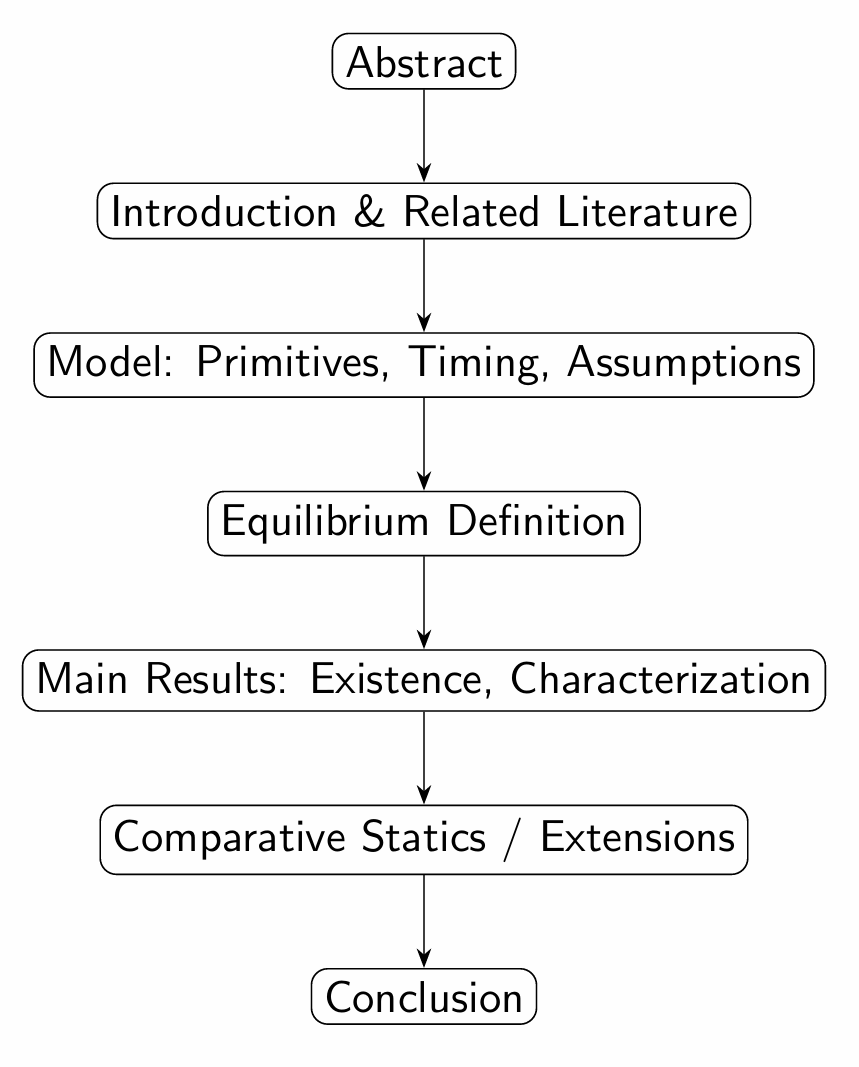
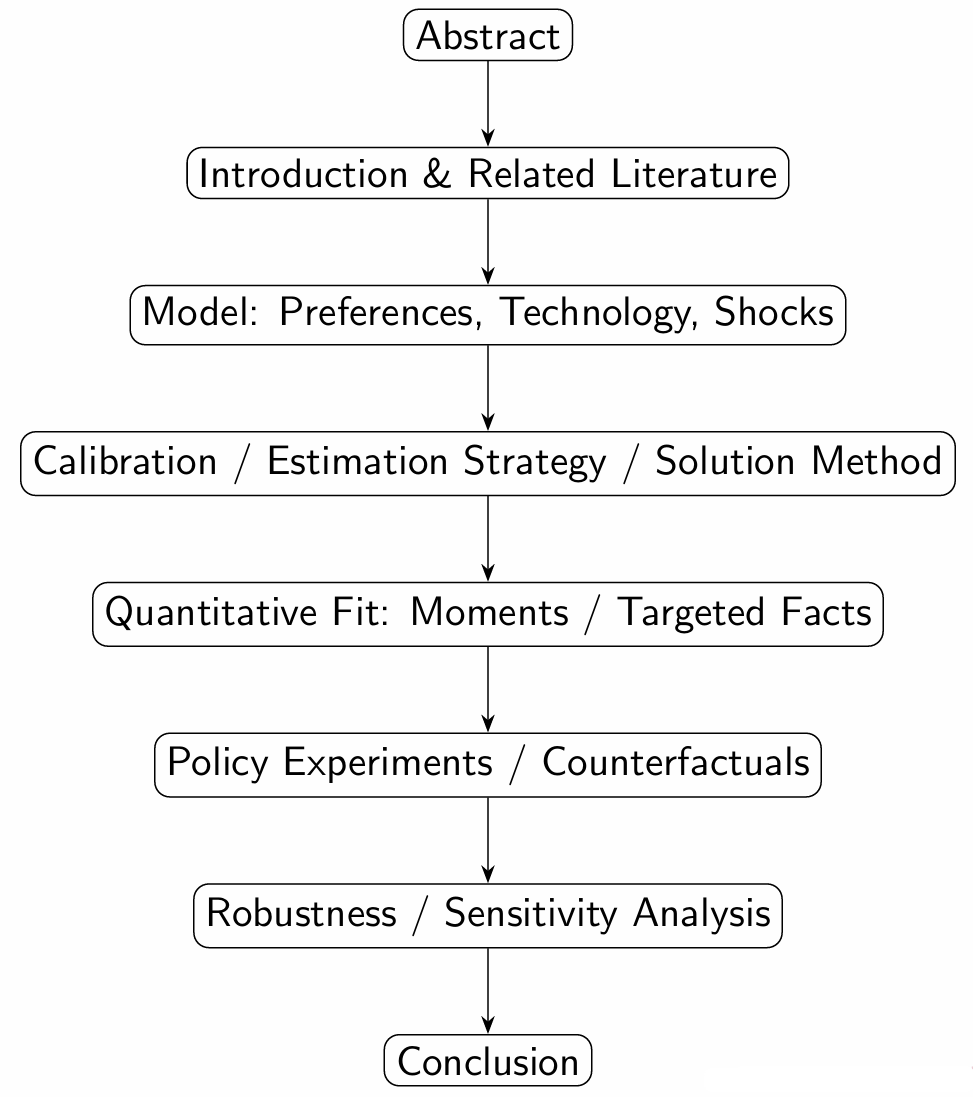
A theoretical JMP (Figure 2) follows a similar logic but places more weight on the modeling section. After motivating the question and explaining its relevance, the paper typically provides an intuitive overview of the environment and key mechanisms before introducing the formal model. The formal section defines primitives, timing, assumptions, and equilibrium definition and characterization; subsequent sections develop the main results and comparative statics. Macro and structural JMPs (Figure 3) typically feature reduced-form empirical evidence, structural parameter estimation, model calibration, quantitative fit assessment, and counterfactual analysis. As with empirical papers, lengthy proofs belong in the appendix, while the main text focuses on clarity and intuition. Regardless of type, the unifying objective is clarity: A reader should never feel lost about the structure of the argument or the purpose of each section.
Crafting the Abstract and Introduction
The abstract and the introduction are, by far, the most important parts of the Job Market Paper. They are the entry points to your work, the basis on which hiring committees form their first impressions. A strong JMP, therefore, should begin with a precise, disciplined, and persuasive opening.
1) The Abstract The abstract must communicate the essence of your paper in roughly one hundred words. Its role is not to summarize everything you do, but to make the reader understand immediately what the paper is about, what you do, what you find, and why it matters. A well-crafted abstract typically follows a clear structure:
Start with the research question, stated plainly and without jargon.
State what you do, mentioning the empirical strategy, theoretical framework, and setting.
Present the main results with magnitudes: numbers matter here.
Close with the key contribution and implications.
Keep the abstract concise. It should be 5 to 7 sentences, or around 100 words. It should contain no vague statements. Background or literature lists should not be included, as the abstract is not the place to “set the stage” but the place to communicate content. Because of this, it should be written last, once the story of the paper is fully clear in your mind.
Exercise 1: Analyze the abstract of your JMP (or one by someone else) according to the discussion above.
2) The Introduction The introduction is the most important section of the Job Market Paper because it’s often the only section that recruiters will read in detail before a flyout. Besides, the introduction is often the only section of a paper that people actually read after publication. Therefore, it needs to be edited and rewritten many times, and should be “perfect”. Keith Head provides a good structure for the introduction:
The Hook. Open with a tension, a puzzle, or a stylized fact that makes the reader care. This is not decoration: it is your opportunity to demonstrate the economic relevance of the problem. (1 paragraph)
Research Question. State clearly what the paper does. A sentence such as: “In this paper, I examine the effect of...” is often the most effective. Avoid vague descriptions or overly broad claims. (1 paragraph)
Why It Matters. Explain the economic importance of the issue. This is where you situate the question in the broader policy or theoretical context. A reader should immediately understand the stakes. (1 paragraph)
Literature Gap. Identify what previous work has not addressed. A typical formulation is: “While prior work has examined X and Y, we still know little about Z”. This gap creates space for your contribution. (1 paragraph)
Contribution. Present your contributions clearly and explicitly. The standard format remains the most effective: “This paper makes three contributions.” Then list them in a logical order, each tied directly to the gap identified earlier. This paragraph tells the reader why your work should exist. (1 paragraph)
Preview of methods and data. Offer a concise roadmap of your empirical or theoretical approach. This is the place to explain how you answer your question: which data, which variation, which model, and which key assumptions. Aim for clarity rather than technical completeness. (1-3 paragraphs)
Preview of the main results. Present the central findings with magnitudes and economic interpretation. Numbers matter here: they anchor your contribution and give the reader a reference point for the rest of the paper. (1-2 paragraphs)
Literature. Nowadays, literature is rarely isolated in a separate section; instead, it is integrated into the introduction and revisited where needed in later sections.
Optional roadmap. Most papers end with a brief roadmap of the structure (“The rest of the paper proceeds as follows”). This is optional: many readers skip it, but it can be helpful if the paper is long or conceptually complex.
Exercise 2: Compare two versions of an introduction paragraph, and tell why the second is better based on the discussion above.
Version 1: Unemployment benefits are an important policy tool. In this paper, I discuss various aspects of unemployment insurance and present some empirical results.
Version 2: This paper asks how unemployment benefits should vary across regions that differ in wages and housing costs. Using administrative data and a quasi-experimental reform in Germany, I show that a more spatially differentiated benefit system can improve welfare by X%.
It is worthwhile to mention here the contribution and positioning of the paper. The recommended practice is to integrate the literature throughout, not only in one section. Strong JMPs weave positioning throughout the introduction and return to it whenever relevant in later sections, helping the reader understand continuously how the argument connects to and improves on what we already know.
You must clearly state what is new in the paper and why that novelty matters for the broader field, and explain why your approach improves on existing work. The contribution should be tied directly to the identified literature gap.
Precision matters when explaining the contribution. Overselling weakens credibility — readers quickly detect exaggerated claims or sweeping statements that cannot be supported. Underselling, however, obscures the value of your work and leaves the reader unsure why the paper should exist. Effective positioning strikes a balance: confident but careful, ambitious but precise.
Writing Guidelines for Subsequent Parts
For each of the other parts of the Job Market Paper, there are some key guidelines, both for keeping in mind when writing the first draft and as a checklist when revising the paper before releasing it.
1) Models and Theory For theoretical or structural JMPs, clarity in the modeling section is crucial. Before presenting any formal derivations, the reader must have a good understanding of the setup. This requires stating clearly the primitives, timing, and assumptions. It is essential to provide the economic intuition before formalizing. Notation should support the argument, not obscure it. A clear theoretical section demonstrates not only technical competence but also your ability to communicate complex ideas effectively.
A well-written theory section offers a clear roadmap of the model, not just equations. The reader should understand why each assumption is made, how the components of the economic environment fit together, and what mechanisms the model is designed to isolate. Technical proofs and long derivations belong in the appendix, allowing the main text to highlight the economic mechanisms that drive the results.
It is also worth noting that employers nowadays increasingly value seeing a (simple) theoretical framework even in primarily empirical papers, as it demonstrates that the author can think theoretically about their empirical analysis.
2) Data Section The data section should demonstrate that you take empirical work seriously and are meticulous in your approach. It should give a clear and coherent picture of the empirical environment, explaining in detail where the data come from, and what period and geographic unit they cover. Explain sample construction and selection criteria carefully and precisely: what observations are included or excluded, how key variables are defined, and which transformations (if any) are applied.
When presenting descriptive statistics, it is often helpful to show the distribution of the main variables — through percentiles, density plots, or simple visualizations — so that the reader can understand the range, variation, and potential sources of heterogeneity in the data. These elements give context to the identification strategy and help the reader interpret the magnitude of the results. Descriptive statistics are also useful for us as researchers to identify potential data issues, such as detecting outliers. You should show variables as they appear in your analysis (e.g., changes rather than levels if your regressions use changes).
Detailed coding decisions, cleaning steps, or complex construction procedures should be clearly documented, but reserved for an appendix or replication package to keep the main text accessible. By the end of this section, the reader should have complete confidence that the empirical analysis is built on a solid and transparent foundation.
3) Identification The identification section is the backbone of any empirical Job Market Paper. This is where you show the reader not only what you estimate but why the estimates can be interpreted causally. A strong identification section first describes, with clarity and precision, the source of variation that identifies the parameters of interest, be it a reform, an instrumental variable, a discontinuity, or an unexpected shock.
A compelling identification section also requires stating your identifying assumptions explicitly. Then you should explain why assumptions are credible with supporting evidence. This is where balance checks, pre-trends, falsification, and placebo tests play a role. The goal is not to overwhelm the reader with tests, but to offer a set of targeted diagnostics that speak directly to the assumptions of the research design. If you use an IV, you should always report first-stage results to support its relevance.
The last critical step in writing this section is acknowledging limitations. Acknowledging them shows maturity as a researcher. Every empirical strategy has weaknesses, and readers expect you to show that you have thought about them and explain how you address potential concerns. Often, limitations that seem fatal to young researchers are accepted by experienced readers if addressed honestly.
4) Presenting Results Once the empirical strategy is established, you will write your results to build a coherent narrative, with each table or figure advancing the story. The first step is to introduce the main specification and the core coefficients. After the main results, the narrative should unfold naturally. Mechanisms, heterogeneity, and alternative explanations are explored in separate but logically connected subsections.
When writing the results, bear in mind that the emphasis should always remain on providing the economic magnitude of the estimates, not simply reporting numbers and statistical significance without translating them into meaningful economic terms. You should interpret signs, sizes, and mechanisms. Readers want to understand how large the effects are, why they arise, and whether they differ across relevant groups or contexts. If coefficients come with unexpected signs, they should be addressed, not ignored. If there are possible alternative explanations, you should address them systematically.
A key suggestion in crafting the results section is to use clean, intuitive figures and tables. A good JMP should have figures and tables that can stand alone with comprehensive notes. They should be replicable from the information given, and fully labeled and clearly titled. Visualization greatly enhances this part of the paper, and a good figure can make a significant difference in how readers perceive your paper2. When using figures, the principle is to use clean and intuitive visual design and minimize clutter.
Tables should be used in a smart way: they should highlight the key coefficients rather than display every robustness check or specification. Avoid tiny fonts or too many decimals. Titles of the tables should state findings, instead of being just “Table 3”.
5) Mechanisms and Robustness A credible JMP does not stop at estimating a main effect; it seeks to explain the underlying mechanisms. This requires designing empirical tests that speak directly to the channels implied by the conceptual framework or the theory. Mechanism exercises help readers understand not only whether an effect exists, but why it arises and under what conditions it might be expected to appear.
Robustness checks complement these exercises by showing that the results are not driven by artifacts. Strong papers approach robustness strategically: they test a focused set of plausible alternative specifications and address specific concerns with targeted tests, rather than using "kitchen sink" robustness checks.
A good strategy to keep in mind in writing this part is to try to put yourself in the position of a potential referee, anticipate their concerns, preempt the 3-5 most likely referee objections, and then address these proactively in your paper. This is also to demonstrate that, as a strong job market candidate, you have thought about potential criticisms.
6) Conclusion Many conclusions simply repeat what was already explained in the paper. This should be avoided. A strong conclusion focuses on key takeaways, explains why they matter, and situates them within the larger debates or policy questions of the field. This is also the place to discuss the implications of the work — whether theoretical or policy-relevant — and to acknowledge limitations honestly. Besides, a brief but thoughtful suggestion for future research gives the paper a sense of openness and direction. The best conclusions leave the reader with a clear sense of contribution, relevance, and intellectual coherence, reinforcing why the project deserves to stand as a Job Market Paper.
Writing and Rewriting
In the end, writing a JMP is about communicating your findings effectively (in English). Good writing will help the reader identify the precise contributions of your paper, making life easy for your reader. Bad writing deters readers from finishing reading your JMP. But more to that, bad writing will be used as a negative signal about your skills as a researcher, since it often accompanies muddled thinking. This section first presents some language guidelines for writing the JMP, which are especially useful for non-native English speakers, and provides insights on how to improve the writing once you already have a draft.
Writing Style: Language Guidelines
A good writing style in economics rests on a few principles. First, an effective paragraph contains only one idea and follows a simple structure. It should begin with a clear topic sentence that clearly states the main point or claim that the paragraph will develop. A good strategy when writing a paragraph is to ask yourself: If I read only the first sentence, do I know what the paragraph is claiming? If not, the first sentence needs to be rewritten.
Second, use short, direct sentences, and avoid “throat-clearing” phrases. Broad and vague openings such as “In recent years, there has been growing interest in…” or “The issue of X has become increasingly important…” add length to the sentence without adding any information. Also, use active voice, as it makes sentences more direct and easier to understand (Use “I show…” rather than “It is shown…”).
Finally, at the word level, you should always remove unnecessary and filler words (indeed, very, somewhat). If you can take a word out without changing the meaning, take it out. Pay attention also to possible repetitions and avoid them. Besides, choose simple words over complex ones when they convey the same meaning. You should avoid acronyms and jargon, especially in the introduction. A reader encountering your work for the first time should not have to decode terminology before understanding the question. But whenever necessary, define terms immediately when used and stick to the terminology.
Here is an example of a Jargon-heavy start: "Using a spatial RDD with a Bartik-shift instrument and an AKM value-added framework, I estimate the LATE of benefit variation on equilibrium outcomes.” A clearer version would be “Unemployment benefits are the same everywhere, yet living costs differ dramatically across regions. This paper asks whether benefits should vary with local prices.”
Rewriting as a Process
Good writing is rewriting, so expect many revisions. It is all about “molding a product” that changes constantly until it finally settles into its final form. Think of rewriting as a process. You should plan for multiple full passes through the paper: full re-evaluations of structure, flow, and clarity. Note that the introduction should be rewritten last, once the rest of the paper has stabilized. Another useful practice is to have your peers review your paper (and be tough with feedback).
During the rewriting process, you will cut many pieces from the previous draft. It is important to maintain a “cut file” for removed text that might be useful later. Version control systems (even manually creating monthly copies of entire project folders) or a disciplined use of tracked changes help prevent chaos as the paper evolves.
Presentations at internal workshops and seminars3 are opportunities to identify unclear aspects of your JMP that need improvement. If seminar audiences consistently get confused and ask clarifying questions about a particular part, that section of the JMP needs revision first.
Common Mistakes Previous sections have set up good practices in writing the Job Market Paper. However, certain pitfalls recur frequently across JMPs. Reviewing them makes it easier to avoid them:
Inflated motivation without a clear economic question. Long introductions with broad statements or policy background but no sharp research question leave readers unsure what the paper is actually about.
Literature “dumping.” Excessive literature review that does not highlight your contribution. Again, strong JMPs “integrate” the literature to highlight the gap the paper fills.
Overly technical exposition. Pages of algebra, formal notation, or econometric detail can overwhelm readers and obscure the underlying intuition. Technical material belongs in the appendix unless it is essential for understanding.
Inconsistent variable names or notation across sections. Using different names for the same concept across sections confuses readers. Stick to your defined terminology.
Burying the main result. When the key finding appears for the first time on page 25, the impact of the paper is lost. The main specification and central results should be presented early and clearly.
Poor writing and repetitive content. This signals muddled thinking to employers. Spelling mistakes and grammatical errors suggest carelessness.
Final Remarks
The “Goldin–Katz ten rules” are a helpful summary of what makes a strong Job Market Paper, and echo with many of the points raised in this lecture:
It is always possible to transform a good idea into a great JMP.
The insights of your JMP will be judged by how you present them.
Your JMP is an exercise in persuasion.
No great paper first emerged from the author’s printer in that form.
No author can see all (or even most) of his or her writing errors.
Most paragraphs have too many sentences, and most sentences have too many words.
The “foot-in-the-door” parts of your written work are the abstract and introduction.
Verbalizing your argument is more difficult than writing it.
Be your own worst enemy.
There are many other rules: See the Goldin and Katz (2009) original pdf file.
Remember, your JMP is the most important component of your job market application. Treat it as your flagship project: choose a question you care about, develop it with rigor, and present it with clarity and precision. Clear structure and careful exposition are as crucial as the substance of your contribution. Rewrite repeatedly and seek honest, critical feedback. You should aim for a paper that a busy economist wants to finish reading.
Notes
The primary focus of this lecture is writing. For generating a promising idea and selecting a project for the JMP, see Lecture 1 in Volume 1, as well as the Opening Lecture and the Closing Lecture.↩︎
See “Lecture 3: Visualizing Economic Research” for a more comprehensive review on this matter.↩︎
More on this in Lecture 4.↩︎