Volume 1 · Lecture 1
Starting a Feasible and Promising Project
Libertad González · UPF & BSE
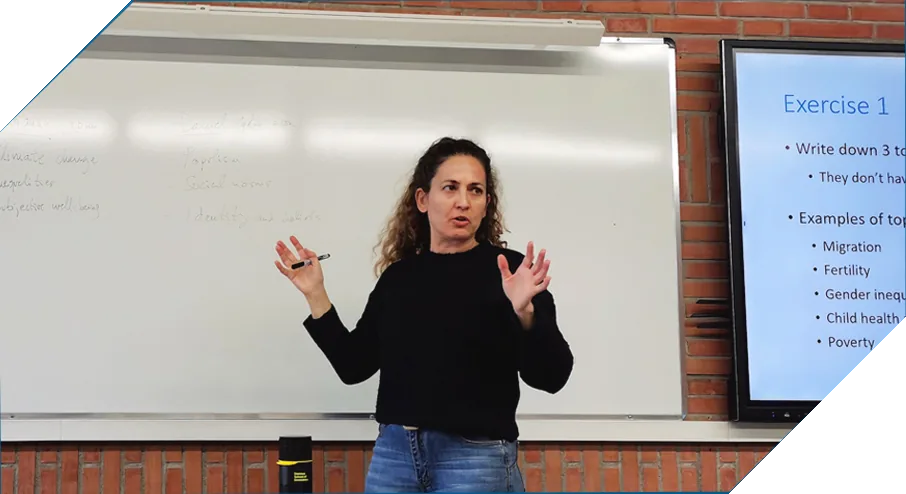
Lecturer: Libertad González. Libertad is a Professor of Economics at UPF and BSE, and a research fellow at IZA, CReAM, and CESifo. Previously, she was the President of the European Society for Population Economics and a holder of an ERC Consolidator Grant. Her research spans labor and public economics, focusing on migration, fertility, gender inequalities, and child health and development.
In this lecture, Professor González focuses on the step of idea generation. As you already know, this is a key step of the process - without an idea, there is essentially no project to pursue. Idea generation is often one of the most anxiety-inducing stages, so getting concrete advice on how to handle it can be particularly helpful! Professor González presents a 6-step process that she thinks is especially effective for developing successful ideas that can become promising papers afterwards.
Contents of this lecture:
To begin with, we need to overcome the tendency to wait for the “big idea”. A common mistake among young researchers is to delay starting a project while reading broadly across topics in search of a perfect idea. Instead, it is essential to start working on something - feasibility and significance often only become clear after some time and effort. Even if the initial idea does not ultimately work out, the process will deepen your understanding of the literature, methods, and data, making the effort worthwhile!
Step 1: Select a Field (or two)
The first step in the idea-generation process is to choose a research field, as well as an advisor. This decision is typically shaped by a combination of factors, including your background and training, personal interests, the expertise of faculty members, and the resources available in your department, among others.
Note that your research does not have to align exactly with your advisor’s work - you have the freedom to explore your own interests within your chosen fields. In many cases, the fields may already be partially defined when you enter the PhD program, or they may take shape during your coursework.
It is essential to be aware of the various possible fields and ensure the chosen one genuinely motivates you. Remember, a field is broader than a topic: for example, labor economics is a field, while gender or migration are specific topics that can be explored within various fields, including labor economics.
Step 2: Select a Topic
Within your field of interest, identifying specific topics that intrigue you is crucial. Since research involves a long-term commitment, it is essential to select a topic that excites and motivates you, just as it was when choosing your field. Once again, consider your personal interests, the connections between these interests and your field, and the topics covered in your field courses, for instance. Importantly, the topics you choose do not need to be traditionally associated with your field. You can be innovative here!
Exercise 1: List three topics that interest you
Hints: These topics do not have to be “classic” economics topics. They can be migration, fertility, gender inequalities in economic outcomes, child health and development, poverty, just to name a few examples.
Some more examples: Tax evasion, tax incidence, corporate income tax and automation; populism, social norms, identity and beliefs; climate change, inequalities, subjective well-being.
Step 3: Find and Evaluate a Research Question
Once you have a topic, the next step is to start formulating research questions within that topic. Remember: a topic is not a question! You can always start out broad from a topic and progressively narrow it down until you arrive at a concrete, researchable question.
Here is an example. Say, you define a topic of interest - migration. Next, you narrow it down a little bit to, for example, the economic impacts of migration, which is still a topic. If you then focus on a specific hypothesized relationship or outcome, you may arrive at a research question such as: What is the effect of immigration on the wages of native workers?
Here, for young economics researchers, a practical tip is to avoid overly broad “why” questions. Instead, try to formulate more focused questions around specific mechanisms or relationships (Do you have any hypotheses in mind?).
Second, once you have a research question, you need to evaluate it. That is, you need clear criteria to judge whether your question is worth pursuing. Typically, a good research question should be:
Relevant: People care about the question, or you can persuade them to care. At the very least, YOU should care about it.
Answerable: We don’t know the full answer, and so can contribute to closing a gap in the literature.
A common question among early-stage researchers is: Where do research questions come from? One important source is the courses you take. At the PhD level, taking courses is no longer only about acquiring knowledge. Rather, it should serve as an opportunity for you to come up with your own research questions. Taking courses in different fields may help you combine new insights gained in class and arrive at novel research questions.
If you are no longer taking courses, seminars and conferences become key sources of inspiration. Listening to others present their work can often spark your own ideas. Lastly, non-academic sources, such as news articles, podcasts, or even casual conversations with friends and family, can also be surprisingly fruitful in generating good research questions.
Exercise 2: Write down two research questions based on your chosen topics1
Okay! So now you’ve completed the first three steps: selecting a field, choosing a topic, and formulating a question. What next?
At this point, it is tempting to begin reading the literature extensively. Indeed, eventually you will need to have a deep understanding of the existing literature in order to identify your own contribution. However, reading too early can be limiting: your thinking may become overly shaped by what has already been done, and this might lead to a contribution that is too incremental.
Instead, you should first think independently about how you would answer your question. That is to say, now is the time to develop a plan. This brings us to the next step.
Step 4: Develop a Plan - Approach and Literature
1. The Approach: methods and identification strategies
“An idea = a question + the proposed method to answer it.” A well-defined plan that details your method is essential after defining your question but before touching the data. That said, building such a plan is not always straightforward. A helpful way to get started is by answering the following questions:
How would you conduct the study with unlimited resources? (What would be the ideal way to answer your question?)
What skills and methods will be required?
A very useful exercise is to imagine the ideal randomized controlled trial (RCT) that would allow you to answer your question. Try to understand what the randomization units would be, what the treatment would look like, and what outcomes you would explore (This exercise tends to be especially helpful for applied microeconomists but can also be useful for other economists).
This thought experiment will help you visualize the structure of your idea, and, if the ideal RCT is not feasible, find the second-best way to answer the question. For empirical micro research, such second-best approaches include experiments (lab, field, or survey-based experiments) or quasi-experimental methods (Instrumental Variables, Difference-in-Differences, Regression Discontinuity Designs, etc.).
What NOT to Do
Don’t just find some data and start playing with it and running regressions!
Remember: simply exploring the data and conducting exploratory regressions is not an identification strategy.
Be ambitious and proactive. If the data you need is not available, look for ways to obtain it or consider generating your own. If you lack certain technical skills, take the initiative to learn them. If the project is time-consuming, start early. If funding is needed, explore potential sources and seek advice from advisors.
But most importantly, leverage your unique perspective: Your background, training, experience, and network provide you with a comparative advantage. Think about research settings and perspectives that you are especially well-positioned to explore.
Key Questions for identifying an approach
What would an ideal Randomized Controlled Trial (RCT) look like for answering your question?
If an RCT is not feasible, can you identify a natural experiment or quasi-experimental setting?
Or, which methods are appropriate (e.g., theoretical models, structural models, causal inference techniques, experiments)?
What assumptions will be needed to answer the question credibly?
2. Conducting the Literature Review
Finally! Once you have drafted a research plan, conducting a literature review helps you understand what others have done and identify your potential contribution. You should expect to find papers addressing similar questions - this is entirely normal (after all, many people are doing research!). The key is to identify what you can do differently or better.
However, bear in mind that you should avoid doing the following (as they do not constitute a meaningful contribution):
Simply replicating a study using data for a different country, without a clear motivation for what new insights could be obtained.
Claiming to “add to the literature on something” without a clear innovation.
Writing a model (per se) without empirical relevance or support.
Claiming to be the first to study something.
Reporting mixed results in the current literature without a compelling explanation of how your project improves on it.
A true contribution should provide new knowledge that was previously unknown, improve existing methodologies, or offer more credible identification.
Step 5: Seek Feedback and Refine the Idea
Okay, now you have a clear question and a structured plan to answer it. However, before moving on to data analysis, it is important to discuss your idea with supervisor(s), peers, and other faculty members. Their input can help you refine both your research question and your approach.
One of the key roles of your supervisor(s) is to leverage their experience and expertise to help you evaluate whether an idea is worth pursuing. So listen carefully to their suggestions! (Fortunately, at UB we also have our Research Ideas Coffee Session Series, which provides an excellent opportunity to receive feedback from your peers. Make sure you participate actively and benefit from it!)
It is worth repeating that this step is crucial. Keeping your ideas to yourself might cause you to miss valuable perspectives or overlook potential issues. Feedback is an iterative process and may lead you to revisit earlier steps. That’s not a waste of time - on the contrary, it’s part of becoming an expert in the research process (which is actually what a PhD is for). So don’t be afraid to ask for help and comments!
The Feedback Loop
After receiving feedback, you will often find yourself at a crossroads. Your advisor, or other people you consult, may give you one of three types of responses:
Great idea! If the project is well-motivated, feasible, and methodologically sound, go ahead and proceed to execution (proceed to Step 6).
The project is not worth pursuing. Perhaps the contribution is too minor, the identification strategy is not credible, or the question is infeasible. (Go back to Steps 2 or 3, and refine your topic or question.)
Unclear. If they are unsure, talk to a few more people, or go back to Step 4 and work further on your plan. Then repeat Step 5.
Remember: iteration is part of the process. Hearing “no” or “not sure” is not failure - it’s a prompt to think deeper and improve your idea.
Step 6: GO! Move Forward with Your Project
Arriving at this point is great news. With the “OK” from your advisor, you now have something to work on! While the execution stage is beyond the scope of this lecture, it is worth noting that there will be many back-and-forths, so make sure to ask for feedback frequently. You can present at internal seminars, talk with additional faculty members, visitors, and more senior students in close fields. From here on, the focus shifts to other key aspects of the research process, which will be addressed in the upcoming lectures.
Bonus: Do’s and Don’ts for Junior Researchers
To wrap up the lecture, here is some extra advice from Professor González. First, a few common practices that may be unhelpful during the PhD, or when pursuing an academic career in general:
Shying away from discussing your project: Engaging with others helps refine your ideas and improve research quality (we’ve already emphasized how important feedback is!).
Rushing into data analysis without a clear plan: Always develop a well-defined identification strategy first.
Starting with a dataset or policy change rather than a research question: Research should be driven by important questions, not just available data (though data and context can certainly inspire good questions).
Following trends instead of personal interests: Study what you are genuinely passionate about.
And also, some general advice that should benefit your PhD journey:
Keep your advisor(s) regularly updated.
Get to know your data REALLY well (read the codebooks, explore descriptive statistics, ...).
Start from a relevant question.
Work on a topic that you truly care about.
Think hard about your (potential) contribution to the literature.
The research process is iterative and requires persistence, creativity, and flexibility. Your initial idea will likely evolve over time, and that’s perfectly fine. What matters is keeping your research question and approach clear. This will help you develop a solid project and ensure a meaningful contribution to the field. And most importantly, HAVE FUN!
Notes
You can also revisit Exercise 1 from the Opening Lecture to deepen your understanding of this step.↩︎